
Industrial access & material handlingEquipment selection support
Industrial Man Lifts

Explore Industrial Man Lifts

Equipment departments

Man Lifts & Aerial Work Platforms
Work Platforms & Access Stands
Industrial Ladders
Scaffolding
Material Handling
Loading Dock Equipment
Aviation & Ground Support
Facility Safety
Guides & checklists
Shop equipment

Aircraft Refueling – How to do it safely

September 8, 2017 news

When refueling an aircraft, several standard rules and regulations have to be followed to ensure that the process is carried out safely. Since aircraft fuel is highly inflammable,…

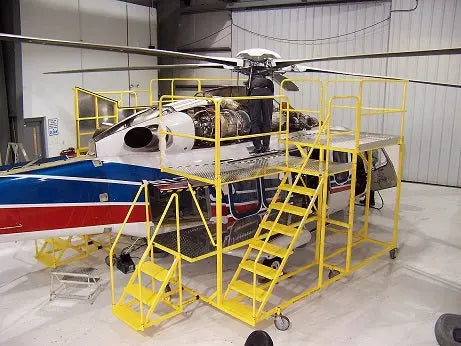
AW139 Helicopter Maintenance Platform 800 Series
Equipment example: AW139 Helicopter Maintenance Platform 800 Series. Confirm the selected model and configuration for your application. View equipment

Some original inline illustrations are unavailable. The equipment photograph above is identified separately.

When refueling an aircraft, several standard rules and regulations have to be followed to ensure that the process is carried out safely. Since aircraft fuel is highly inflammable, negligence on part of the refueling staff can lead to devastating consequences. Common safety precautions that must be followed during aircraft refueling The personnel involved in the refueling process must make sure that they follow the safety guidelines give below at all costs:
  • Avoid smoking during the refueling process
No smoking must be allowed near the aircraft while the refueling process is being carried out. The air around the refueling vehicle often becomes saturated with fuel vapors. Flames, sparks, and extreme sources of heat can easily ignite these vapors and lead to a catastrophic disaster.  The ground staff must not carry matches or lights with them to keep the risk of a potential fire hazard to a minimum.
  • Electrostatic charge buildup should be prevented
The aircraft, fueling vehicles and fueling equipment must be kept grounded to ensure that there is no buildup of static charge. The absence of an effective grounding mechanism can prove to be extremely hazardous as it could cause the fuel to ignite and explode.
  • Always keep a fire extinguisher ready
A fully functional fire extinguisher must be kept nearby to deal with unexpected accidents. The fire extinguisher must be clearly visible to the fueling staff and easy to access in case of an emergency. The fueling staff must also be properly trained to use the extinguishers to deal with fire hazards. The extinguisher must also be routinely checked to ensure that it is in proper working condition. Original illustration unavailable: fire-extinguisher
  • Keep electronic items powered off
All electronic items (such as cell phones and portable music players) must be powered off during the fueling process. No electrical output terminals must be present near the fueling vehicle or the aircraft itself. Since electronic items can cause sparking, they pose a grave threat in the vicinity of vehicles and containers carrying aircraft fuel.
  • Avoid fueling aircrafts during bad weather conditions
If there are signs of a storm, it is best to delay the aircraft refueling process till the weather improves. Lightning strikes can create static discharges in the atmosphere and cause the fuel to combust. Original illustration unavailable: weather-conditions
  • Make sure that the caps are tightly sealed.

Once the aircraft is refueled, the staff must ensure that the fuel tank caps are properly sealed. Tightly secured caps will ensure that fuel vapors do not escape from the tank. A loose cap, on the other hand, can pose a serious threat to the aircraft and its passengers as it could lead to the spillage of the plane’s fuel. Industrial Man Lifts is a reliable provider of industrial mobile work platforms, aircraft maintenance stands, and different kinds of ladders and lifts. To learn more about our maintenance equipment, call us at our toll-free number (727) 490-8839, or email us at [email protected].  

FAQ

What does this guide cover?

This article explains Aircraft Refueling – How to do it safely and the decision points that typically matter for industrial buyers.

How do you choose the right access equipment for the job?

Start with working height and footprint constraints, then confirm capacity, safety requirements, and how often the equipment must be repositioned.

How do I get pricing or confirm fit?

Request a quote with your application details and we’ll respond with pricing, options, and best-fit guidance.

Related Articles

More resources that may help your equipment selection.

More guides & checklists

High-value resources designed to be easy to reference and share.

Resource hub

Ready to get pricing?

Need pricing or availability?

Request a quote with your requirements and our team will follow up fast.

No obligation B2B sourcing

Get pricing fast

No obligation • Specialists

Get Pricing